Poet Cameon Wade on Creative Instinct and a Life Shaped by Story
Moving between the written, spoken and on-screen worlds, she is creating a growing body of work and personal style that reflects the same lived-in honesty
By: The Lace Ledger Staff
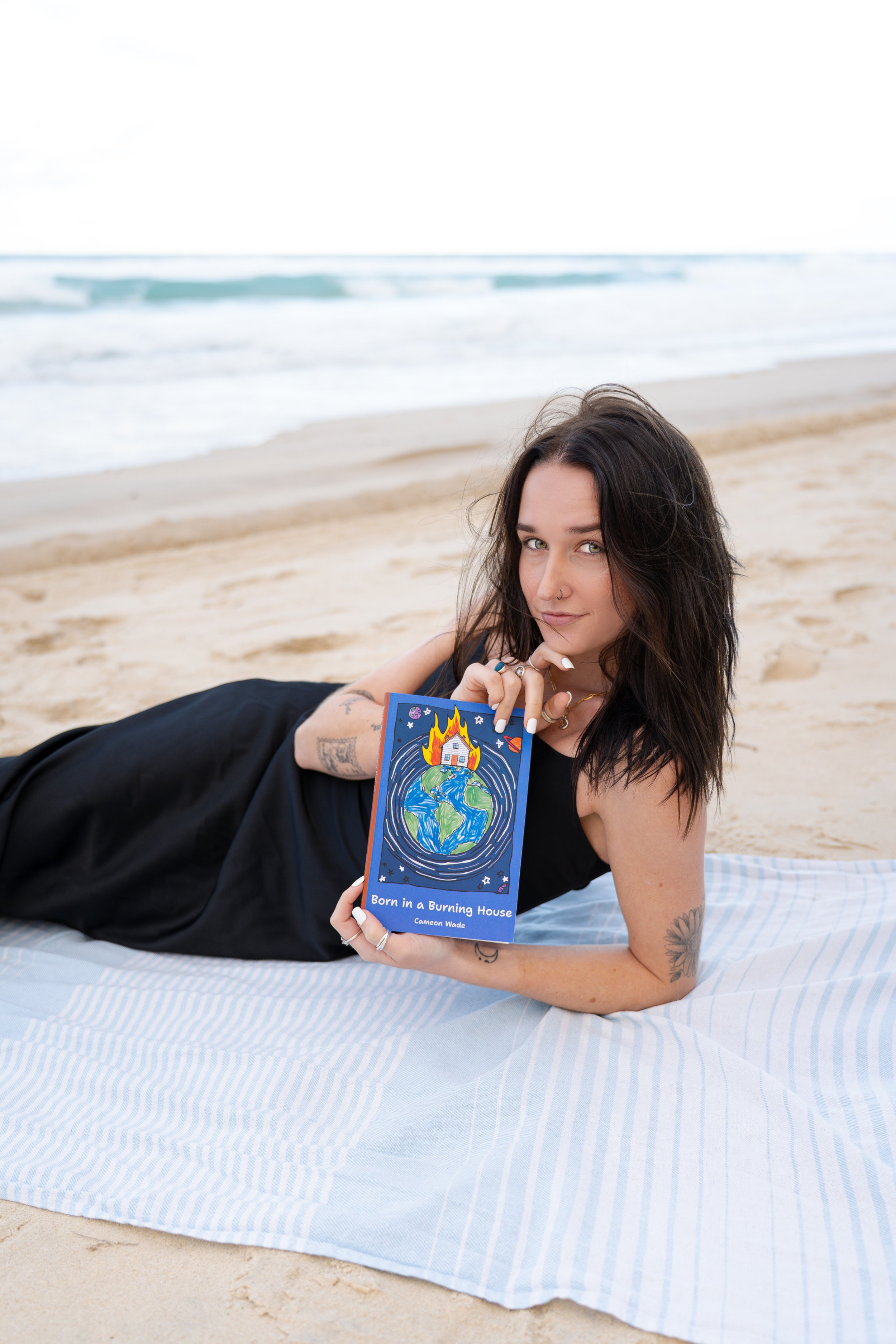
Image courtesy of Cameon Wade
Not every poet is easy to recognize.
There’s no uniform. No fixed setting. No single way the work is supposed to appear. No perfect moment or atmosphere. The muse turns up in trenches, and a working poet must be prepared.
Cameon Wade creates on the move, telling stories that readers recognize themselves inside. Her work evolves as she does.
In doing so, she has carved out a space in contemporary poetry that meets people where they are, giving language to experiences that are often difficult to articulate and, in the process, making that experience feel a little less isolating.
Here, we meet her in that movement, following how ideas take shape and how they are expressed, offering us a glimpse into the life of working poet, in real time.

Image courtesy of Cameon Wade
1. You work across several forms of storytelling, from poetry to documentary film making. When did you first realize that narrative would become central to your professional life?
Not to sound poetic but, I think storytelling found me before I even realized how big of a part of my life it was.
I was always paying attention to small details others seemed to overlook and I had this urge to capture it. The small things in life felt so much more prominent than people realized.
Poetry was the first place that instinct had somewhere to go. I remember being six years old and writing “song” lyrics in my barbie journal. I was going through things a kid shouldn't have to and therefore didn’t know the first thing about coping with it, but I was lucky enough to be able to translate my emotions into words.
Later, when I picked up a camera, I realized film could do something similar. It allowed me to capture the world the same way poetry captures a feeling through fragments, atmosphere, and small moments that say more than a full explanation ever could.
No one in my immediate family pursued the arts, I was raised very traditionally with lives surrounded by 9-5s, going to college, getting a degree and joining the work force so, for a long time, I considered my urge to story tell a hobby. It wasn't until I combined the two mediums I realized what I wanted to do with my life was capture it.
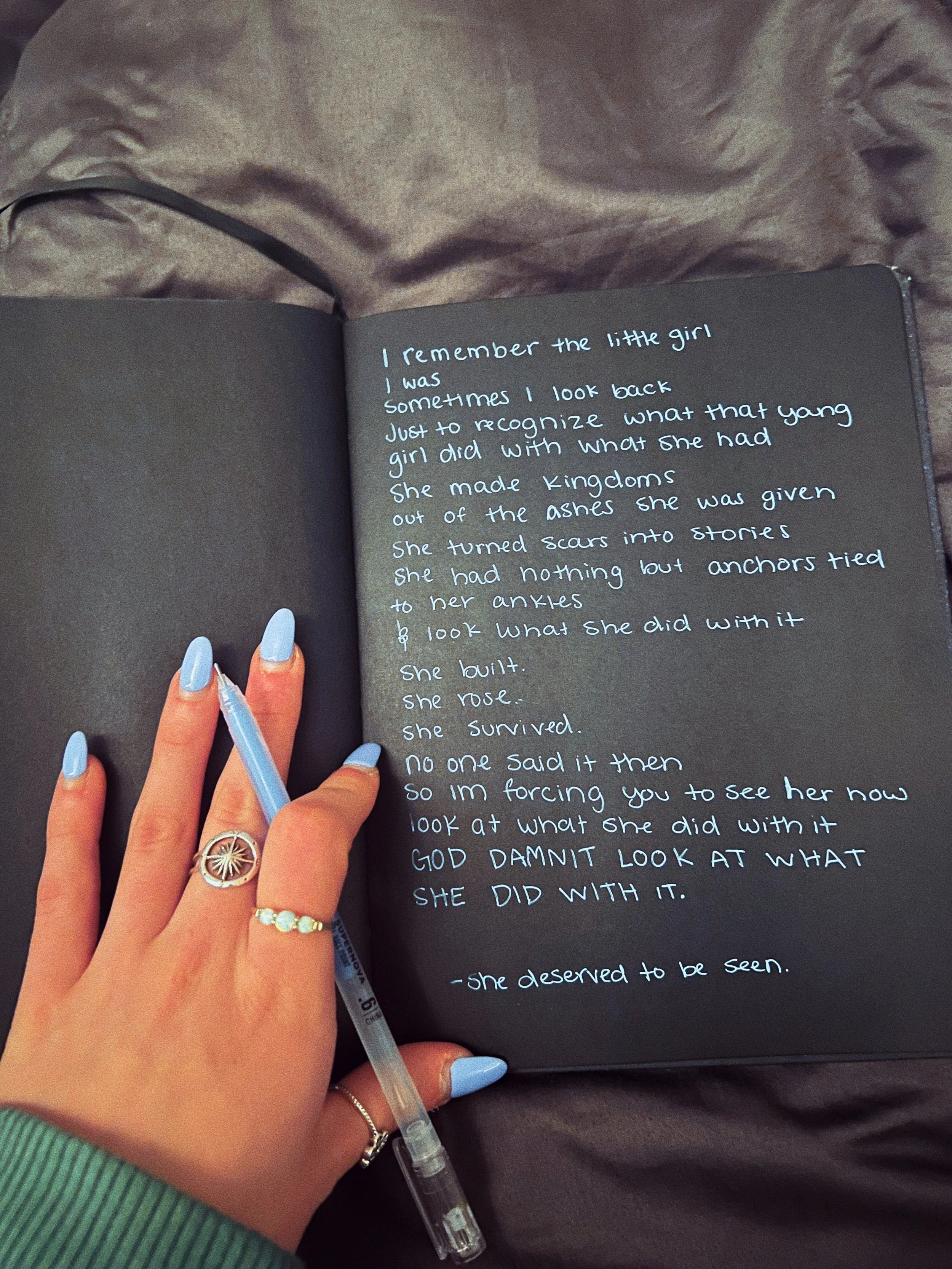
Image courtesy of Cameon Wade
2. Poetry lands differently when spoken aloud than when encountered on the page. How do you consider that distinction when you write vs when you speak?
Yeah, I think about that a lot actually, because I write very differently depending on how the poem is meant to be experienced.
When I’m writing something I know I’m going to perform, I’m thinking about my voice the entire time. The pacing, where I’m going to breathe, where I want to speed up or slow down. I naturally lean more into rhyme and rhythm in those pieces because it helps carry the listener, it gives the poem a pulse.
Spoken word for me is almost physical. I can feel it in my body while I’m writing it. I know where a line needs to hit, where I want silence to sit, where I want something to feel like it’s building or breaking.
But, when I’m writing something for someone to read on their own, it shifts. I’m not controlling the pace anymore, they are. So I write it more like a story. A little more open, a little less structured, and more focused on how it unfolds in someone’s mind rather than how it sounds out loud.
I think both are still honest, just in different ways. One is guided. I’m walking you through exactly how it should feel. The other is more of an offering you get to meet it at your own pace and take what you need from it.
3. Writers, including our team, often absorb inspiration from unexpected places—struck in the shower, on a dog walk, in the grocery store or in the car—in equal measure to taking in important cultural moments, emotional milestones or works of art. What creative influences continue to shape your work today? Grand and mundane?
This is a funny question because it truly is both. When I was truly getting into poetry around my third book, I would play this game with my friends. The game was simple. They would tell me an object and an emotion and I would be tasked to write about it in 10 minutes. It was just a way for me to get better at writing and push myself out of normal emotives.
One of these poems is actually in Born in a Burning House:
“i often drive at night
finding myself under the streetlights
and in a way, i see myself in them
to be something people only used
after dark”
They gave me the object of streetlight and the emotion of loneliness, and that's what I came up with.
A lot of my poems come to me while I'm driving, or right before I'm about to go to sleep. Very rarely do I sit down with no ideas and go, “okay I need to write something,” they really do come to me. I’ve always resonated with that ancient Greek idea of the muse, that creativity isn’t something you control, it’s something that visits you. Like you’re being trusted with something for a moment. You can’t force it to show up, you just have to be open enough to receive it when it does.
So I don’t really go looking for inspiration anymore. I just pay attention, and trust that when something lingers long enough, it’s meant to become something.

Image courtesy of Cameon Wade
4. You have already published five books early in your career including Darling, Spine Full of Medicine, Silent Thoughts, Through the Phases and Born in a Burning House. How has your relationship with poetry evolved as you’ve grown as a writer?
Ironically, as I continue to write, I almost dislike my past work, especially from when I was a teenager, because I look back like, “omg how did I ever think this was good.” But that's truly the beauty of it. I have proof of growth, I have printed fossils of my life, the things that I went through, the fires I survived.
My favourites are Through the Phases, and Born in a Burning House because these are two projects with such a clear theme and when I truly started finding my voice.
5. Which authors and poets do you seek out for inspiration?
My favourite poets are Courtney Peppernell, Yung Pueblo and RH Sin. Pillow Thoughts was actually the series that gave me the courage to publish my first book.
When I'm struggling with writer's block, that's a book I always go back to. Yung Pueblo’s Clarity & Connection, was a book that got me through a really difficult time in college. I loved how deep and metaphorical this work was.
I’m not a big fan of “simple” poetry; to be honest, a lot of mainstream authors don't force me to think or feel as much and I believe poetry is supposed to. It's art, it should make you sit with it to understand it.

Image courtesy of Cameon Wade
6. Every working and aspiring writer encounters moments when the words feel distant. Do you have a tried-and-true hack for overcoming writer's block?
HA writer’s block? What a bitch. If I had a tried-and-true hack, you’d be the first to know. I’ve had months where I don’t write anything. And I’ve had seasons where I can only write the beginning of a poem, but for the life of me can’t finish it; which is honestly one of the most frustrating feelings, especially when you exist on social media where “consistency is key.”
I used to internalize that a lot. I thought, if I wasn't actively writing, I wasn't a poet. But I’ve learned, you can’t force art, you have to feel it.
So, my “hack,” if you can even call it that, is to step away. I remind myself that I’m still a poet even when I’m not writing.
I also struggle with my mental health, and there are times when poetry starts to feel like work. That’s usually my sign to take a break, because it’s something I genuinely love it shouldn’t feel like a chore.
So I go live. Have a glass of wine with my best friend, take an everything shower, go for a drive and listen to devastating music, I just choose to exist. I stop asking, “what should I write about?” and just trust that when something is ready to be said, it’ll find me. and it always does.
7. Ernest Hemingway once wrote: "In order to write about life, first, you must live it." Does that philosophy resonate with you as a storyteller?
Yeah, I think I’ve learned that the hard way.
I have a habit of leaving when something goes wrong in my life. I’ll book a flight, change my environment, and chase something new. Part of it is curiosity, but part of it is definitely avoidance too. I think I’m a bit of an adrenaline junkie in that sense. I crave the feeling of being somewhere unfamiliar, where everything feels alive again. But, those experiences have shaped me in ways I couldn’t have gotten any other way.
A lot of my writing comes from conversations. Sitting with people I’ve just met in different parts of the world and somehow getting into the deepest parts of their lives within an hour. It’s shown me how big the world is, but also how small it becomes when you realize we’re all carrying the same kinds of things just in different forms.I think that’s what makes that idea resonate with me.
You can’t really write about life if you’re not out there experiencing it, messing it up, running from it sometimes, and then coming back to face it. For me, writing is what happens after all of that. After the movement, after the conversations, after the adrenaline wears off and I’m left sitting with what it all meant.

Image courtesy of Cameon Wade
8. Your poetry reaches a large and ever-expanding audience through social media. How do you navigate the vulnerability that comes with sharing deeply personal work so publicly?
I think I’ve had to redefine what vulnerability means to me. In the beginning, it felt like exposure, like I was giving pieces of myself away and hoping they’d be handled gently.
But, over time, I realized that sharing doesn’t have to mean sacrificing myself. Now I see it more as offering. I choose what I give, how I give it, and when. A lot of my work is deeply personal, but once it’s written, it doesn’t belong entirely to me anymore. It becomes something other people can step into and see themselves in. I no longer am the main character and instead am just the one reading the story.
I also have honestly separated my social media presence with my real life. I forget people that know me see it sometimes and when a close friend brings it up I’m honestly like, “omg right my diary is on the internet,” but it's something I laugh at instead of feeling embarrassed or ashamed of.
At the end of the day, we’re all human beings experiencing the same things in different ways. The details might look different, but the feelings are often the same. I think there’s something really powerful about being open about that. If I can put words to something someone else hasn’t been able to explain yet, it makes them feel a little less alone and that matters to me. I don’t mind being that voice for people who feel lost sometimes, because I’ve been there too. And I know how much it can mean to hear someone say something you thought you had to carry by yourself.
That being said, I’ve also learned to protect parts of myself. Not everything has to be shared to be real. Some things are just mine, and having that boundary is what allows me to keep showing up honestly in the first place.
9. Your work in Born in a Burning House move through difficult emotional terrain with remarkable clarity. What kind of inner work shaped the writing of this book?
Born in a Burning House was my longest working project. I had written for three years before sitting down and organizing all the thoughts in a way that made sense. I actually write the poems before I come up with a theme for the book. Born in a Burning House was a collection of poems I wrote in a very raw time of my healing. I was doing a lot of EMDR and somatic healing and a lot of my childhood was coming to the surface, writing was the way I could really move through it.
There were a lot of those, “oh that did happen to me, and that really shouldn't have,” moments.
The poems you read in Born in a Burning House were poems I wrote in those moments of my healing, and how I moved through to acceptance.
10. "I once loved a boy" is a favourite poem at The Lace Ledger office. It has a hauntingly beautiful, accurate way of capturing the struggle so many men face today (and their romantic counterparts right along with them). You sounded like you were speaking from the collective memory of so many women today. Can you tell us a little bit about the story of this poem.
I was never expecting to get that kind of support for that poem to be honest with you. I never realized it was such a relatable topic, and it kinda broke my heart to see all the women and the men in the comment section speaking of how it spoke to them.
I once loved a boy started with loving someone who struggled deeply with how they saw themselves. It was a poem I wrote about a relationship I was in where my partner carried a level of self hatred & insecurity in himself that I couldn't understand. I remember this hollow feeling listening to how he spoke about himself, and I would try to tell him over and over again the things his mind is telling him just isn't true. But you can't force someone to believe you. Every time I complimented him he’d say I was lying and I mean it really just broke my heart. Because the dislike he felt about himself was so powerful he wouldn't even believe the person who loved him more than anyone in the world. All I wanted was for him to see himself the way I did. This kind, considerate, intelligent man, believing he was worth nothing.
I think the hardest part was realizing he didn’t just struggle to love me because of it, he struggled to love himself. And eventually, that turned into resenting me for seeing something in him he couldn’t see on his own.
11. As you continue to grow as a writer and filmmaker, what creative directions feel most exciting to you right now?
The combination of both mediums truly. Having the gift of being able to turn emotions into words paired with visuals to truly bring out the movement in other people. I really have been so blessed with my support in my poetry, I hope to soon have the same support for my film making.

Image courtesy of Cameon Wade
12. Lastly, the fashion world is currently embracing "poetcore", a mood that borrows from dark academia and literary romanticism. From the perspective of someone who actually lives as a working poet, what would a truthful version of poetcore look like in 2026? If Cameon Wade conceptualized "Poetcore," how would readers get the look.
I feel like “poetcore” online is very romanticized, dim lighting, leather journals, slow mornings, everything feeling a little cinematic. And I get the appeal, but if I’m being honest, that’s not what my day-to-day looks like at all.
My style changes a lot, but I’m most comfortable in streetwear. Baggy jeans, layered t-shirts, jerseys just things I can move in and exist in without thinking too much about how I'm being perceived. I love cargos, I love pieces that feel a little worn in. It’s less about looking like a poet and more about feeling like myself. I don’t always post that side of me, so people don’t necessarily associate it with my work, but it’s there. You can catch little glimpses of it on my Instagram.
If I were to define “poetcore” in a real way, it wouldn’t be about a specific look. It would be about honesty. Wearing what feels like you in that exact phase of your life even if it changes all the time. Because that’s how poetry actually works too. It’s not one aesthetic. It shifts, it evolves, it contradicts itself sometimes. So I think a truthful version of poetcore in 2026 is less about dressing like an idea of a poet, and more about embodying your own perspective fully whatever that looks like that day. Because I guarantee you, meeting me in person you'd never know I was a poet, and I kinda prefer it that way.
Not every creative life will look like this. It shouldn’t.
The work asks for something personal from all of us. It asks you to pay attention and to follow what holds, even when it doesn’t arrive on the timeline we would like.
There will be stretches where the muse is elusive. Remember Cameon’s advice: step back into your life. Go out. Have adventures. Let your experiences inspire something new or offer a fresh perspective. Your body of work will soon be decorated with the passport stamps of those experiences.
For those eager to explore Cameon’s work further, her books are available on Amazon. You can also follow along on Instagram and TikTok to experience her spoken word as it unfolds.
For more conversations like these, subscribe below to receive our free monthly digital issue, delivered to your inbox.