The Dark Feminine Gallery: 16 Gothic Masterpieces & Their Hidden Meanings
From formidable heroines to notorious villains, discover the women and mythology behind some of art history's most captivating works
By: The Lace Ledger Staff
Some of art history's most captivating women have terrible reputations. Others paid dearly for their convictions. And a few have been immortalized in paintings that tell us more about humanity and culture than the women themselves.
We've gathered 16 of our favourite gothic masterpieces from art history, each with a fascinating story to tell. Behind their haunting imagery lie timeless reflections on the human condition, revealing the shifting perceptions of women over centuries.
For the dark feminine woman, there's plenty to admire, and perhaps a little wisdom to take home.
L'Envoûteuse (The Sorceress), Georges Merle, c. late 19th century

Photo Credit: Wikimedia Commons
A sorceress bends over a smoking vessel, absorbed in mysterious spell work. Merle draws on the nineteenth-century fascination with occultism and the femme fatale, portraying a woman whose knowledge and power exist beyond the reach of conventional authority. Her direct gaze challenges the viewer, almost daring them to question what she's doing.
There is nothing demure about this sorceress; she commands her own mysterious domain with the confidence of a woman who knows her worth and has no interest in seeking anyone's approval or input.
Judith Slaying Holofernes, Artemisia Gentileschi, c. 1620

Photo Credit: Wikimedia Commons
Bloodied and resolute, Judith drives a sword through the neck of the Assyrian general Holofernes, aided by her maidservant Abra. Drawn from the biblical Book of Judith, the scene celebrates a woman who saves her people through extraordinary courage, while Gentileschi's unflinching portrayal has often been interpreted in connection with her own experience of sexual violence and the public trial that followed.
Unlike many male artists who depicted Judith as a delicate heroine, Gentileschi gives both women physical strength and agency, making this Baroque masterpiece a powerful study of female resistance.
The Nightmare, Henry Fuseli, 1781

Photo Credit: Wikimedia Commons
A sleeping woman lies sprawled across her bed, seemingly helpless beneath the weight of a grotesque demon, while an unexplicable ghostly horse peers through the curtains. Drawing on folklore once attributed to nightmares, Fuseli gives physical form to the invisible burdens of the unconscious mind. The sinister creature becomes a compelling metaphor for the fears and desires we suppress, yet continue to carry with us.
Centuries later, The Nightmare invites us to consider how much influence our subconscious holds over our waking lives, and the importance of confronting what weighs on us before it begins to consume us.
Perseus and Andromeda, Titian, c. 1554–1556

Photo Credit: Wikimedia Commons
Andromeda finds herself at the centre of a terrible injustice, condemned to be sacrificed to a sea monster for an offence she never committed. Titian depicts the dramatic arrival of Perseus, who swoops down to rescue her, in a masterpiece commissioned for King Philip II of Spain as part of his mythological poesie series.
Beneath the romantic heroism lies a troubling imbalance: Andromeda is denied any agency in her own fate, yet her suffering becomes the foundation of someone else's heroic legend. Today, her story reminds us of the importance of women having autonomy over their own lives, including the right to be the authors of their own stories.
The Storm on the Sea of Galilee, Rembrandt van Rijn, 1633

Photo Credit: Wikimedia Commons
A fishing boat is nearly swallowed by monstrous waves as Christ and his disciples struggle against a violent storm on the Sea of Galilee. Inspired by a biblical account of Jesus calming the waters, Rembrandt's only known seascape places us in the middle of the chaos, where even the most experienced sailors are powerless against nature.
There's a compelling lesson in its darkness: courage doesn't always mean conquering the storm; sometimes, it means finding the faith to weather it.
And, the painting has weathered a storm of its own: it was stolen from Boston's Isabella Stewart Gardner Museum in 1990, alongside twelve other artworks, in one of history's most notorious art heists. Its whereabouts remain unknown. There's an eerie parallel between the subject and the painting's fate: a masterpiece about surviving catastrophe has itself vanished into uncertainty.
Spirit, George Roux, 1885

Photo Credit: Wikimedia Commons
The nineteenth century was captivated by the possibility of life beyond death, and Roux's ghostly female figure gives that fascination an ethereal form. The French artist, celebrated for illustrating Jules Verne's extraordinary tales of exploration and discovery, worked during an era when séances and Spiritualism captivated audiences across Europe.
For a dark feminine interpretation, the spectral woman offers an intriguing reversal of the traditional muse: a presence that continues to command our attention, even in death.
The Fallen Angel, Alexandre Cabanel, 1847

Photo Credit: Wikimedia Commons
Cast out of Heaven for rebelling against divine authority, Lucifer stares back at the viewer with a single tear falling from his furious eyes. Cabanel's portrayal gives the fallen angel a strikingly human vulnerability, inviting us to consider the pain beneath his defiance.
Lucifer's story raises a provocative question about power: when does refusing to submit become an act of self-determination, and who gets to decide whether that rebellion is righteous or unforgivable?
Diana and Actaeon, Jean-Baptiste-Camille Corot, 1836
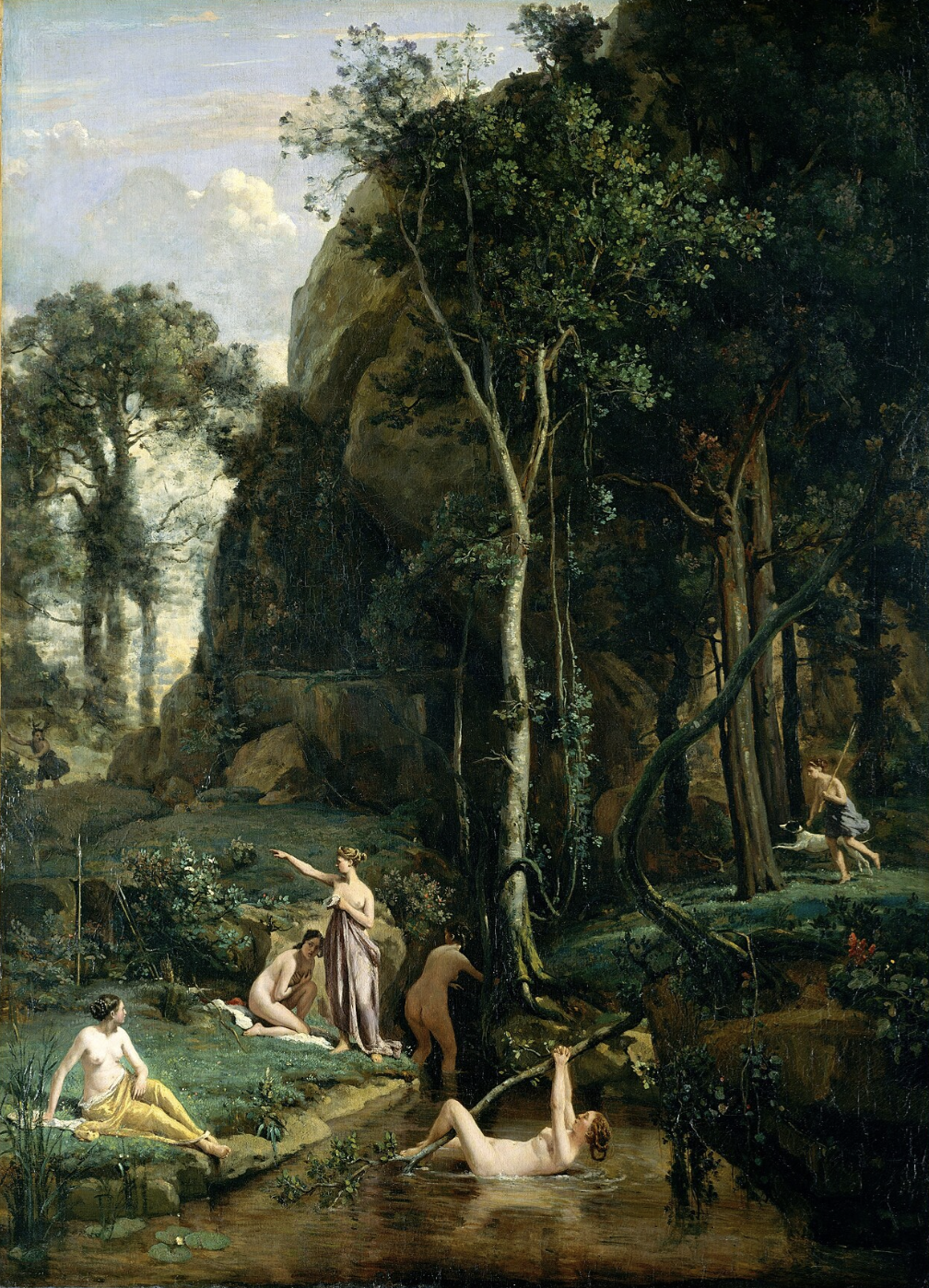
Photo Credit: Wikimedia Commons
Deep within a secluded woodland, Diana, goddess of the hunt, bathes with her nymphs as the unsuspecting hunter Actaeon intrudes upon their sanctuary. According to Ovid's Metamorphoses, the furious goddess transforms him into a stag, leaving him to be torn apart by his own hunting dogs.
Corot gives this ancient tale an atmospheric, almost enchanted setting, capturing the moment before Diana reminds an unfortunate mortal that a woman's boundaries are hers to enforce, and violating them may come at a dire cost.
The Lady of Shalott, John William Waterhouse, 1888

Photo Credit: Wikimedia Commons
In this watery scene, a young woman drifts downriver toward Camelot, having abandoned the tower where a mysterious curse condemned her to view the world only through a mirror from high in her keep. Inspired by Alfred, Lord Tennyson's poem, Waterhouse depicts the Lady's final journey after she defies the curse to look directly at Sir Lancelot, choosing a fleeting taste of freedom despite its fatal consequences.
The painting offers a haunting reflection on female autonomy and the price of pursuing a life beyond the one prescribed for you. And for Anne of Green Gables fans, a nostalgic deep cut ;).
La Belle Dame sans Merci, John William Waterhouse, 1893

Photo Credit: Wikimedia Commons
A mysterious enchantress inspired by John Keats's 1819 poem, La Belle Dame sans Merci (The Beautiful Lady Without Mercy) draws an armoured knight toward her, her long hair entwining him as she prepares to steal his heart. Like a siren luring sailors to their doom, she seduces men into a fatal enchantment, depicting a woman whose beauty and independence make her simultaneously irresistible and threatening.
Yet, there is something subversive about the reversal of power: the knight arrives dressed for battle, only to discover that his armour offers no protection against a woman who knows exactly how to wield her charms.
Joan of Arc Enters Orléans, Jean-Jacques Scherrer, 1887

Photo Credit: Wikimedia Commons
A heroine's welcome awaits Joan of Arc as she rides triumphantly into Orléans, greeted by the people whose liberation she has come to secure. Painted more than four centuries after the events of 1429, Scherrer's monumental work celebrates the teenage peasant girl who defied the expectations of her sex and social standing to become a military leader during the Hundred Years' War.
Her extraordinary story remains a powerful testament to female conviction, particularly the courage required to claim authority in a world determined to deny it. The darker chapter of her legend makes that triumph all the more poignant: Joan would be burned at the stake for heresy at just nineteen, only to be declared a saint centuries later.
Joan's legacy offers a powerful reminder that conviction demands courage. Standing by your beliefs may come at a great personal cost, but that doesn't mean you won't change the course of history.
Witches' Sabbath by Francisco Goya, 1797–1798

Photo Credit: franciscogoya.com
Beneath a moonlit sky, a gathering of witches surrounds a horned devil as an infant is offered in a sinister ceremony. Commissioned by the Duke and Duchess of Osuna, the painting draws on the terrifying folklore used to demonize women accused of witchcraft, while reflecting Goya's criticism of superstition and the Spanish Inquisition.
More than two centuries later, the image invites a familiar question: how often are women vilified simply for challenging the beliefs and expectations of their time?
Lady Godiva, Jules Joseph Lefebvre, 1890

Photo Credit: Wikimedia Commons
According to medieval legend, Lady Godiva repeatedly petitioned her husband to relieve the people of Coventry of their oppressive taxes. He finally agreed, but attached one condition: she must ride naked through the town as part of some … frankly perverse … humiliation ritual.
Moved by her willingness to sacrifice her dignity for their welfare, the townspeople are said to have remained indoors with their windows shuttered, honouring her privacy. Lefebvre depicts this selfless act of courage, reminding us that vulnerability deserves respect, and that true solidarity means protecting the dignity of those who put themselves at risk for others.
The Wild Hunt of Odin, Peter Nicolai Arbo, 1872

Photo Credit: Wikimedia Commons
Thunderstorms were once believed to herald the arrival of Odin's Wild Hunt, a terrifying procession of supernatural riders sweeping across the night sky. Arbo brings this ancient Norse legend to life with Odin at its centre, accompanied by his ravens and a fearsome host of warriors, including Valkyries, the mythological women who chose which fallen soldiers would enter Valhalla.
Odin's fearless charge offers a powerful reminder that when the moment calls for courage, fortune favours those bold enough to lead.
Tamara and the Demon, Konstantin Makovsky, 1889

Photo Credit: Wikimedia Commons
A beautiful young princess finds herself pursued by a fallen angel whose lust for her threatens to destroy them both. Inspired by Mikhail Lermontov's narrative poem The Demon, the painting draws on a tragic Georgian legend in which Tamara retreats to a convent after her fiancé's death, only to be visited by a supernatural suitor who promises her an extraordinary love. His fatal kiss ultimately claims her life, though her soul is saved by an angel who refuses to let the demon possess her in death.
Beneath its Gothic romance lies a chilling warning about obsessive love: passion becomes dangerous when devotion gives way to possession, and even the grandest declarations of love mean little without respect for another's freedom.
Lilith, John Collier, 1887

Photo Credit: Wikimedia Commons
Entwined with a serpent, Lilith embodies one of mythology's most notorious female figures. According to medieval Jewish folklore, Lilith was Adam's first wife, created as his equal, who refused to submit to his authority and abandoned the Garden of Eden rather than surrender her independence.
Her rebellion saw her recast as a seductive demon, blamed for everything from sexual temptation to infant mortality.
Collier's sensual portrayal captures the allure of this original dark feminine provocateur, whose story raises an enduring question: when a woman refuses to obey, who decides whether she is dangerous or simply free?
As we thoughtfully adorn our own gallery walls, we hope you'll consider making room for some of history's most fascinating and formidable women. Beyond their beauty, these works carry centuries of mythology, rebellion and cultural history, offering an opportunity to appreciate the stories that shaped our understanding of femininity and the women who challenged it.
Which will you add to your collection? And what would you add to our list?
Tell us in the comments, and subscribe to receive our free monthly digital issue straight to your inbox, including a first look at breaking trends, the chance to vote on next month's stories and a preview of upcoming giveaways.