From Spark to Studio: Mary & Shelley's Deadstock Design Philosophy
Lindsay and Natalie revisit the years between an ambitious idea and the independent leather goods label they imagined all along
By: The Lace Ledger Staff

Photo Credit: Mary & Shelley
Great ideas have a funny way of torturing their creator until they are fully realized.
The first spark behind Mary & Shelley appeared years before the brand itself. Long before the leather guitar bags, the deadstock materials and the devoted community, there were two alt fashion students with a shared passion in horror and music and ambitious to pursue design. The concept lingered, bubbling beneath the surface, through corporate careers and years spent learning the realities of an industry they would one day disrupt. Rather than rushing to build something before they understood it, they allowed the idea to mature alongside them.
For impatient individuals (present company included) immersed in a hurry-up culture; this method can feel tortuous. Yet Mary & Shelley is a reminder that some of our best ideas need time to mature like a well-cellared vintage, developing depth and character before they're finally uncorked.
Ahead, founders Lindsay and Natalie revisit the origins of Mary & Shelley, unpacking the realities of building an independent fashion brand and sharing why patience became one of their greatest creative assets.
1. Mary & Shelley began with a friendship forged in fashion school and a shared feeling that something was missing from the market. Take us back to those early years: how did you meet, what first drew you to one another creatively and when did the idea of eventually building a brand together begin to take shape?
Yes! Our story began as fashion school classmates at Kent State University in Ohio.
From those early college days, we connected over many of the same creative influences. Neither of our individual styles has ever fit neatly into one category, but we both love secondhand shopping and are drawn to alternative-leaning fashion influence. But what may have brought us together just as much as fashion itself, is our shared love of music and horror movies. Our first hangout involved watching the now-cult-classic Jennifer’s Body, which feels very on-brand in retrospect!
After graduation, we stayed close and were always pointing out things we wished existed, half-joking that we should make them ourselves. It was more of a recurring daydream than a business plan.
We kept finding ourselves in the same in-between space. With mainstream fashion feeling too safe, while a lot of alternative fashion options felt fast, over-designed, or tied to one specific look or subculture. The more seriously we looked at that gap, the more we began to wonder whether other people were searching for the same things.
We both ultimately left our corporate fashion jobs, and Natalie began working with independent brands as a freelance design consultant. That took things to the next level. She saw female founders building businesses without huge budgets, big teams, or perfect timing. Suddenly, starting something of our own didn’t seem so far-fetched.

Photo Credit: Mary & Shelley founders
2. Deadstock sits at the heart of everything you create, but it may be unfamiliar territory for many readers. In the simplest terms, what qualifies a material as deadstock, how do you find it and what made you decide to build your design process around materials the wider industry had already left behind?
In short, deadstock in the fashion industry, is any material produced but never ultimately used. In our case, that often means high-quality leather is purchased, tanned, dyed, or finished for larger or well-known fashion brands. It may then become available for a number of reasons, a brand overordered, canceled or discontinued a style, rejected a slight color variation, or simply had material left over.
The leather is still beautiful and perfectly usable. It just no longer has a destination. Rather than allowing it to sit unused in a warehouse where it’s eventually sent to a landfill, we source it. Many of the factories and suppliers we work with already have deadstock leather available, so that part of the process is as simple as asking for what they have.
But it does limit our options as a design house. We cannot simply order any leather we want in any color, texture, or quantity. Once we have a design, we have to find deadstock that meets our standards and is available in enough quantity to produce it. And once that leather is gone, it may be gone for good. A successful design cannot always be recreated in the exact same material later. That can make planning more complicated and time-consuming, but it also means no two production runs are quite the same. Yet each run does feel a little exclusive or unique.
And the idea of breathing life into something “dead” is built into the brand itself. The Mary and Shelley brand is a nod to Mary Shelley, the 19th-century author of Frankenstein. Giving new life to beautiful materials the fashion industry casts aside is not just practical. It’s become part of our brand story.

Photo Credit: Mary & Shelley
3. After working in fashion, you both grew tired of the wastefulness and repetition you were seeing. At a time when trends move faster than ever and wardrobes are increasingly treated as disposable, what do you think the industry misunderstands about overconsumption? How can designers encourage people to buy fewer pieces without sacrificing the excitement and self-expression that make fashion so compelling?
Fast fashion, in particular, often treats overconsumption as though it is entirely the customer’s fault, while creating systems designed to make people feel dissatisfied with what they already own. It offers a quick fix at an easy price point.
Especially now, social media sends trend cycles into hyperdrive, making people feel constantly behind and overwhelmed by choice.
But the desire to express ourselves is innately human. That is part of what makes fashion meaningful, and we don’t believe the answer is to remove the joy from it.
For us, encouraging people to buy less does not mean asking them to care less about personal style. We do not expect one brand to define someone’s entire wardrobe. Personal style comes from mixing things together: vintage finds, independent designers, something borrowed, something unexpected.
Our products are meant to become part of the customer’s larger story, not dictate the whole thing. That’s where self-expression comes in.
Ultimately, we don’t want any part of sustainability to feel like a sacrifice. Most people will not buy something simply because it is the more responsible option. They have to genuinely love it.
For us, the more conscious choices are built in naturally because they are important to us.

Photo Credit: Mary & Shelley
4. Mary & Shelley feels as though it exists somewhere between a vintage record shop and a 2000s music video. Your designs embrace nostalgia without ever feeling trapped by it. How would you define the brand's aesthetic, and how do you balance those influences with creating pieces that feel timeless enough to carry every day?
That’s a fun and accurate description! Mary & Shelley lives somewhere between vintage music culture, dark romanticism, alternative fashion, and feels like the kind of unusual objects you might stumble upon in a strange old shop and become obsessed with.
We’ve always been deeply drawn to nostalgia, and even to anemoia, the longing for an era you never experienced firsthand. Lindsay, for example, is super into vintage rock and metal from before her time. But we are equally interested in the present and in creating new experiences, so we never want the brand to feel like a reproduction of one specific era.
Nostalgia is most interesting when it acts as a doorway rather than a destination. We may begin with a memory, a film, a musician, or a vintage object, but then ask how that reference connects to what we want to express now. Sometimes it leads somewhere completely new.
The goal is for the initial reference to create an emotional pull, while the final product feels strong enough to outlast the trend cycle.

Photo Credit: Mary & Shelley
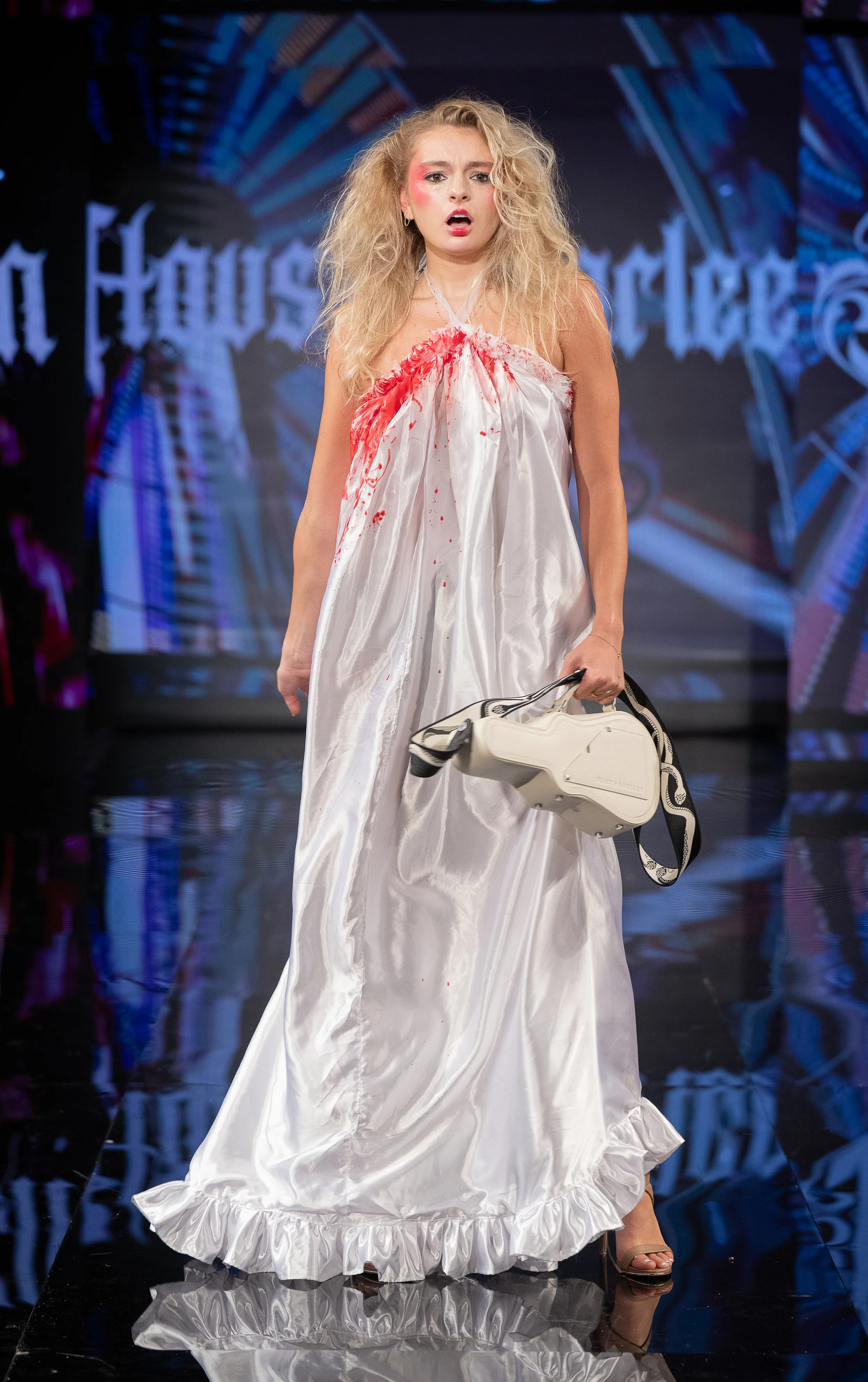
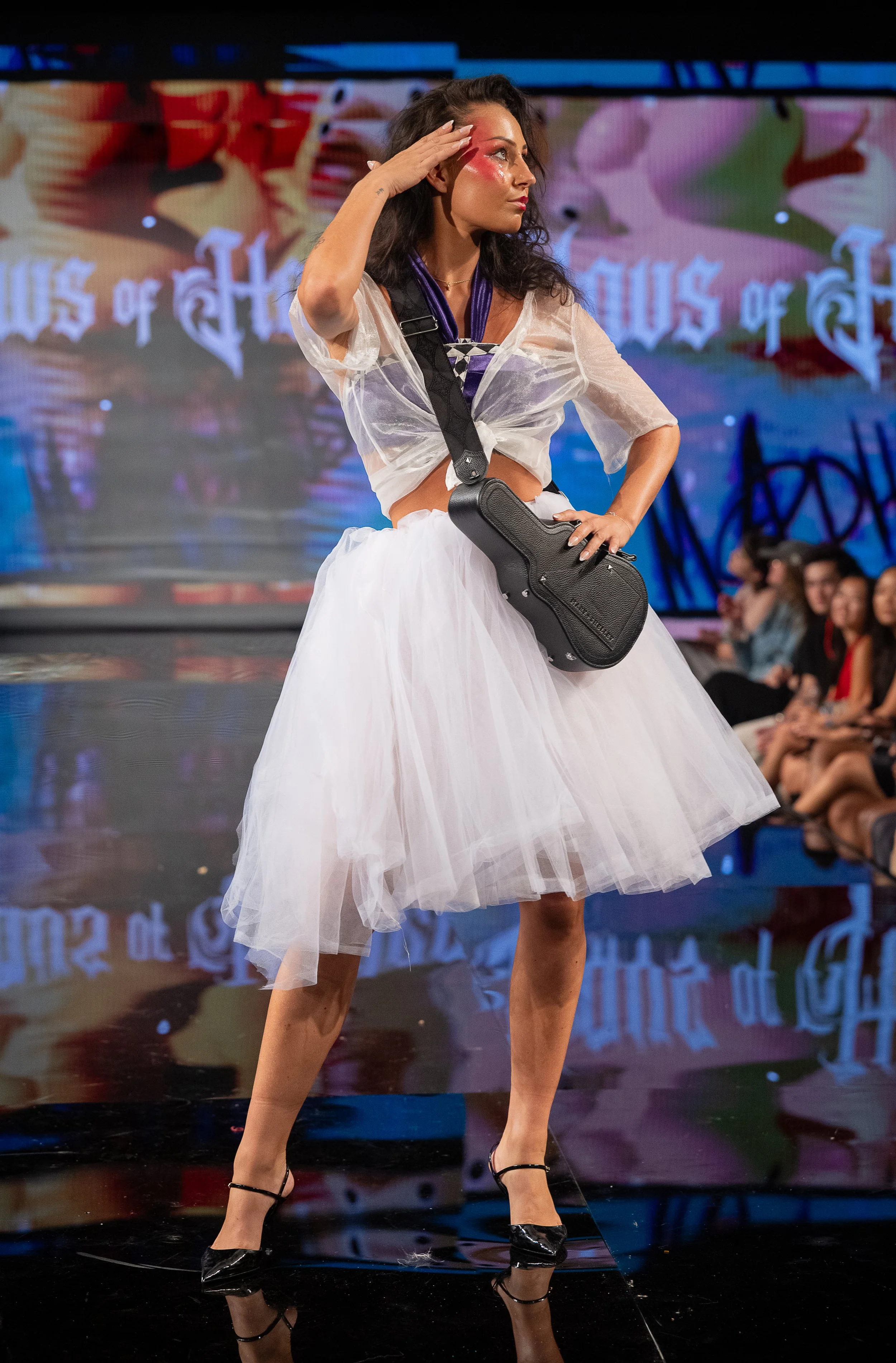
5. Your guitar case bag has become something of a signature for the brand. We'd love to hear the story behind it. Where did the idea first come from, and how did you transform it into the piece we know today?
Well, our signature bag actually started with a $50 vinyl guitar bag Natalie purchased, modified and was embarrassed to carry.
She had just started taking guitar lessons and was prepping for a trade show with one of her freelance clients. The client’s brand is very 1970s rock-and-roll inspired, so Natalie wanted to wear things that represented the 70s aesthetic but stayed true to her own personal style.
So she kept thinking: you know what would pull these looks together? A guitar bag. Something that kind of straddles the line between bold and understated. Professional. Not covered in giant logos or over-the-top novelty.
She had also remembered seeing a pink Moschino guitar case bag on Gilmore Girls many years ago, and loved the idea of finding something similar in black. The closest thing she found was a $50 vinyl guitar bag covered in patches, graffiti, and a very loud studded strap. So she tried to make it work.
She replaced the strap, ripped off the patches, and used permanent marker to cover some of the writing. She was a little embarrassed to carry it. But people loved it. They kept stopping her to ask where she got it.
The bag itself started falling apart not long after, but it was proof that people were drawn to the idea. So she came back to New York and immediately started sketching. It seemed like the perfect product to launch the brand we always talked about.
And then we took the guitar idea one step further. The removable strap does not just look like a guitar strap. It can actually be used on a real guitar.

Photo Credit: Mary & Shelley
6. Every scratch, crease and softened edge tells the story of a well-loved bag. How do you hope your pieces evolve over time, and what does it mean to you to create accessories designed to be lived with rather than replaced?
Leather changes when you actually live with it. It softens. It creases. It picks up little marks along the way. We do not necessarily see those changes as damage. We see them as part of the story. Almost like a tattoo that brings you back to a certain time in your life.
Our motto is “made to be loved to death,” and we mean that quite literally. We are not designing bags to sit untouched on a shelf or only come out for special occasions. We want them at concerts, dinners, on trips, and during completely ordinary days.
The more they are carried, the more personal they become.
There is something meaningful about an object slowly becoming unmistakably yours. In a culture that constantly encourages replacement, choosing to keep, care for, and continue loving something can feel surprisingly intimate. Like an heirloom.
7. The fashion industry constantly chases what's next, yet Mary & Shelley seems devoted to creating pieces that people will keep for years. How do you stay committed to that philosophy in an industry that often encourages the opposite?
We stay committed by thinking about purchases in terms of cost per wear. A piece may cost more upfront, but if it is well made and worn again and again, it can offer far more value than something inexpensive that is quickly replaced. That is exactly where we want Mary & Shelley to sit.
Not disposable, but not inaccessible, status-driven luxury either. We think of our bags almost as an alternative girl’s answer to a vintage Coach bag: special, long-lasting, attainable, and designed to gain character with wear.
For us, encouraging people to buy less means creating pieces that not only feel exciting at first, but are functional and durable enough to become part of someone’s daily rituals and maybe even a signature piece. That philosophy helps us resist the pressure to release something new just for the sake of newness.

8. As your brand continues to grow, what are you most excited to explore next, and where do you hope the journey takes you?
We’re super excited to keep expanding both the product line and the community around it.
That means new bag shapes, other accessories, and a few garment ideas we’re excited to bring to life. Music will always remain central to the brand. We would love to deepen that connection through more collaborations with musicians, artists, and independent creatives. The fact that our straps can move between a handbag and a real guitar gives us a natural bridge between fashion and performance that we have only started to explore.
At the same time, we are equally excited about collaborating with other alternative brands and designers that share our space and community. That could take the form of product collaborations, unconventional runway experiences, events, or unusual retail spaces. All of those things give us a way to tell a larger story and connect with our community far beyond a traditional product launch or something confined to a phone screen.
Ultimately, we want Mary & Shelley to grow into a lasting alternative brand for people who have never felt fully represented by conventional fashion categories, while staying true to the strange, personal, and rebellious qualities that made us start in the first place.

Photo Credit: Mary & Shelley
Mary & Shelley is proof that the best ideas are often worth waiting for. Their approach to deadstock feels refreshingly thoughtful, giving beautiful materials another life without compromising on design or quality.
We can't wait to see what Lindsay and Natalie create next. Shop the collection here and follow along on Instagram to keep up with new collections and subscribe below to receive our free monthly digital issue, where conversations like this continue to unfold.