Known on social as @theautisticmortician, Emily shares a compassionate account of the customs and care surrounding death in the USA
By: The Lace Ledger Staff

Photography by Luke Martin
Even the most articulate among us can find ourselves searching for words when confronted with death and grief. Perhaps our discomfort with the unknown explains why we're often reluctant to ask what happens behind the doors of a funeral home.
Emily Murman, the licensed funeral director and embalmer known on social media as @theautisticmortician, is helping make those conversations a little easier. Her candour offers a compassionate introduction to a profession many of us know surprisingly little about, revealing the meticulous attention given to those in its care. Emily also brings the perspective of an autistic woman who has experienced profound personal loss, giving her an intimate understanding of what grieving families may be facing. Her advice on supporting someone through bereavement is especially thoughtful, acknowledging that grief follows no prescribed course.
Emily's creative pursuits extend well beyond the funeral home. An accomplished poet, she explores the complicated relationship between our physical bodies and our understanding of mortality. She's also collaborating with professional workwear brand MEA, advocating for clothing that accommodates the physical demands of funeral service.
We spoke with Emily about the experiences that drew her to mortuary science, the importance of honouring individuality and how working with the dead has encouraged her to live more authentically.
1. Gothic culture has long been fascinated by the morbid, but working in funeral service brings you face-to-face with the realities of death. What initially drew you to the profession?
In many ways, I think my life had just been priming me for funeral service until the light switched on and I asked myself, “Wait, I can do this?” The three things that drew me to the profession were my lifelong special interests in all things death-related, the realization that I’m autistic, and a traumatic loss.
I grew up homeschooled by a then-undiagnosed autistic mom, and she encouraged me to pursue whatever I was interested in, no matter how strange it seemed to other people. One of my earliest memories is of visiting the Body Worlds exhibition when it came to Chicago. I was only five years old. I was also completely captivated by a field trip my homeschool co-op took to Graceland Cemetery. I conducted funerals for all of my childhood pets, complete with little headstones my dad made for them out of plywood and stone-effect spray paint. In short, I was weird and morbid, and this was not discouraged. I did not grow up in a household that was death-denying, nor did I grow up in one that discouraged me from being my autistic self.
I also dealt with a lot of loss as a child, both in the traditional sense and in the form of missed opportunities to make friends and experience a sense of community, which I believe were largely related to my autism. All of my grandparents died before I was eighteen, and by the time I was twenty, I think I’d attended at least twenty funerals. One aspect of my autism that I didn’t recognize until much later was my fascination with social ritual as a means of understanding how humans interact, and I think there was something about the ritual of funerals that appealed to me growing up.
When I was sixteen, my sixty-five-year-old grandma died very unexpectedly. My sister and I found her body, and the experience was extremely traumatic. My grief was exacerbated by the fact that at her visitation, my grandma looked nothing like herself—her hair was wrong, her makeup was wrong, and they hadn’t used her dentures, so her face looked wrong, too. My intention here is not to slam somebody else’s work, but I do want to highlight how important it is that we pay attention as funeral service professionals, because my two last images of my grandma are both awful. Ten years later, I’m still thinking about that.
That experience really reawakened my special interest in funeral service. I started reading more about embalming and restorative art, trying to figure out what went wrong since the funeral directors had said she was not beyond repair. I remember feeling like maybe I could do better. Though I was two years into my undergraduate writing degree, I became very fixated on the idea of becoming a mortician, even telling my parents that if I were to drop out, I’d go to mortuary school. At the time, however, I was not mentally stable, and my grief had made me a danger to myself. I think my parents saw this immensely sad teenage goth girl and were scared. They had no idea that there might be some validity to this desire independent of my suicidality, and they encouraged me to finish up my degree. Looking back, I think they were right, because I would not have been emotionally equipped to become a mortician then.
After graduating, I fell into teaching, and it was during those years that I really began to understand my autism. Unfortunately, educational environments can be quite ableist, and there is a certain pressure to uphold that ableism yourself, particularly when you’re expected to model socially acceptable behaviour for children. I found myself masking constantly, and after four years of trying to make teaching work, I reached a breaking point. I told my now-husband, “I need to quit and go do this mortician thing,” and within the span of about a week, I’d quit my job, visited mortuary school, applied and been accepted, and started working in a funeral home.
Almost immediately, I felt that funeral service was a perfect fit for me as a human being. All of a sudden, parts of my autism that had been seen as socially unproductive were very productive in a job. I like to lead, I’m task-oriented, I appreciate social situations that involve a certain script, and I love to be creative. I’m also very detail-oriented, and I’ll do everything I can to make a funeral just right.
Becoming a mortician has been one of the hardest things I’ve ever done, but it’s also the most soul-affirming and neuro-affirming thing I’ve ever done. Losing my grandma was the worst thing that ever happened to me, and I would never recommend entering funeral service purely as a way of working through complicated grief, but my own grief ultimately served as the catalyst that pushed me right into something I’d been drawn to my entire life.

Photography by Emily Murman
2. What does an average workday look like for a funeral director and embalmer, if there is such a thing? We'd love a glimpse behind the scenes, including something about the profession that might surprise our readers.
There’s never truly a typical day in funeral service, but since I like to categorize things, I sort my workdays into three types I call office days, wake days, and arrangements days. On what I call an office day, I usually get to work and spend the first few minutes checking email, finishing my makeup, and making to-do lists. Sometimes, I might know I have an arrangements conference the following day, so I’ll spend most of my time making calls, sending emails, getting my file ready for the appointment, entering data into the funeral home’s software, making sure that the decedent has been embalmed, providing all necessary authorizations have been signed, and following up on yet-unfinished tasks for other services I’m working on. In between all of this, I might be answering phone calls or greeting and assisting people coming into the funeral home. These days can be quite exhausting, but they’re always productive.
The second kind of day is what I call a wake day, and these are probably my favourite. If all has gone well, I’m getting to the office knowing that everything I’ve needed to do on the back end is already done and I can focus on getting ready for my wake and funeral service, whether they’re both taking place that day or I’m setting up for a traditional evening wake with a funeral the following morning. I’m cosmetizing my decedent, setting up the chapel, hauling ass with giant floral arrangements, setting out prayer cards, finalizing the car list, and gathering my go-bag, which is filled with the Catholic funeral rite, a casket key, tissues, pallbearer gloves, funeral stickers, any checks for clergy, and my permits. I’m also making coffee and getting ready to walk the family in, knowing that later, I’ll take out their service. I love these days because I’m up and moving, and they deeply satisfy my just-right OCD. I also usually have about twenty minutes before I meet my families, during which I can take a few deep breaths, have some coffee, and do some primping, which is another added benefit.
My third kind of day is an arrangements day. This is absolutely the most taxing. I'm meeting a family to make arrangements, and while a smooth arrangements conference might take me two hours, you never really know how things will go. Sometimes there are a lot of family members involved. Sometimes people are so upset that it's difficult to get through the decision-making process. Sometimes they bicker, or even fight. Back when I was an apprentice, I once had a six-hour arrangements conference. After arrangements, I'm extremely neurotic about immediately completing my tasks, whether that means filing death certificates, placing orders, obtaining permits, making sure the decedent is prepped, or calling churches. I try to do as much as humanly possible during the remainder of my shift, because I never know when I’ll get another first call, and I don’t want to neglect something and forget about it or find myself with an unmanageable workload as tasks accumulate. Unfortunately, it can be difficult trying to accomplish all of this after a socially exhausting conference, but I’m grateful that my colleagues respect my need for quiet, focused time and generally leave me alone on these days.
One thing people might not realize about my job is how much it resembles event planning. I'm relying on several outside people such as cemeterians, clergy members, florists, doctors, hospice nurses, and families to help me get things done. Probably eighty percent of what I do involves paperwork and communication with these people, following up with them to make sure my service runs smoothly. If one of those people makes a mistake and something goes wrong, I have to take responsibility for it because I'm the funeral director. I never want to be in that situation, but it can be incredibly stressful trying to anticipate and prevent problems not entirely within my control. One time, I made thirty-four phone calls in a single day.
3. Funeral service requires tremendous compassion and professionalism, particularly when supporting families through some of their most difficult moments. What do you find most fulfilling about your work?
There is nothing quite like the feeling of being able to give my families the chance to see their loved one looking like themselves. Sometimes, this takes hours of restorative and cosmetic work, but the work itself is satisfying. As someone whose grief was complicated by rushed, inaccurate restoration on my own family member, I put significant pressure on myself to provide a comforting final image of the deceased and am always seeking out new techniques to expand my skillset. I have stippled multiple cosmetics to get skin tones right, styled and trimmed wigs, sculpted noses out of mortuary wax, and pieced together broken craniums. I will do whatever it takes, and when someone turns around and hugs me saying their viewing experience has helped heal something inside them, I am deeply honoured.
4. Grief is a universal experience, yet it can be incredibly difficult to navigate. What advice would you offer someone experiencing a significant loss? And how can we best support a loved one who is grieving?
I begin by telling people that grief is not a linear journey, and there will be moments that surprise them as they learn to navigate it. Most of us are at least vaguely familiar with Elisabeth Kübler-Ross’s stages of grief (denial, anger, bargaining, depression, and acceptance), but do not realize that the model was originally developed to describe the experiences of people facing a terminal illness, not the bereaved. We don’t typically spend one calendar year moving cleanly through these stages until we reach a point of total acceptance, and it’s important to give ourselves grace rather than hold ourselves to expectations or apologize for our emotions.
While I am a firm believer in therapy, I have also seen how therapy-speak can encourage people to pathologize or distance themselves from grief, treating it as something to be healed from or handled properly. The reality is that sometimes, grief is just incredibly messy. It can make us strangers to ourselves, disrupting not only our routines and relationships, but our own understanding of who we really are. It can make us irrational, withdrawn, or self-destructive in ways that surprise or even frighten us. I speak from experience when I say that there are some losses people never truly get over. Instead, we learn to live with the way those losses change us. Reaching out to safe people when we can't handle things alone is important, and licensed professionals can be an incredible resource.
If you are trying to support someone in grief, please remember that their grief is not about you. I understand how validating it can be to show up for someone, but it is not your job to be the hero in their story. Talking too much about your own experiences, questioning them about things they may not be comfortable sharing, offering unsolicited advice, speaking in platitudes, or imposing your system of belief on them by saying things like, “she’s in a better place now,” or, “God has a plan,” can be excruciating for someone in grief. Sometimes, that person might not even be able to answer questions like, “what do you need?” The power of quiet presence—a grocery delivery, an afternoon spent watching a comfort film together, a long hug—is underrated. Sometimes the best thing you can do is listen. Sometimes the best thing you can say is, “I’m sorry. This really fucking sucks.”
Photography by Jody Murman
5. Has working so closely with death changed the way you approach your own life? We're curious whether those experiences have influenced your everyday habits, your priorities or even your willingness to take risks.
Oh, absolutely. I am not scared of death, but the thought of dying having lived unauthentically, confused about who I am, shakes me to my core. Having grown up in a family of nurses and attended many funerals, I never really saw death as something to be feared, but since entering my field, my desire to get the most out of the time I have here has grown exponentially.
My grandma, who I mentioned earlier, was very likely autistic, and though she wasn't an unhappy person, she died confused about who she was. She didn't understand why she preferred to isolate herself despite loving her family so deeply, or why she couldn't seem to ‘hack’ friendships and romantic partnerships. My sister was in the diagnostic process when our grandma died, and as I learned more about the genetic component of autism and began to realize that I myself am autistic, I couldn't help but wonder if she would have died more at peace with who she was and how she operated if she, too, had figured this out.
By the time I decided to go to mortuary school, my mental health was at one of the lowest points it had been since undergrad. Four years of teaching and witnessing ableism directed towards both myself and my students had worn me down. I was overweight and experiencing body dysmorphia, trying to plan a wedding, and terrified by the thought of going to college a third time with little more to go on than blind faith that it might be worth it. A good quality of life is a human right, and that felt like something I hadn't been able to access for maybe a decade. I was very angry. I was scared, too. I told my now-husband that I was only ever going to wear business clothes to school and that I would stay guarded to keep people from finding out how weird I am. Looking back, I am ashamed that I felt that way, but all of my eggs were in one basket, I was still finding my footing in the field, and I wanted to succeed.
So there I was, poorly masking my autism, finding myself in an educational environment that felt just like high school, and getting picked on for being weird anyway. I knew things other first-generation future funeral directors did not. I got a little too excited about Victorian mourning traditions. Some of my classmates told me an autistic person could never possess the social skills needed to direct funerals. Others misread my passion for thanatology as gauche and provocative. I wasn't even halfway through my first quarter when I decided that there was no point in masking my autism and making myself palatable unless it was absolutely necessary.
Naturally, the bullying continued. It was triggering and inconvenient, but it made me fight for what I wanted even harder, and outside of school, something amazing was happening. My life was improving drastically. I ended relationships that weren't serving me, began dressing exactly how I wanted, fought harder for the relationships that mattered, started taking better care of myself, and ‘came out’ as unabashedly, ridiculously, beautifully autistic.
I was much more comfortable with uncertainty, too. The third quarter was odious, and I thought I'd fail out of accounting and organic chemistry. I remember telling myself that even if this didn't ultimately work out, I would still die one day having gotten to embalm at the Cook County Medical Examiner's Office. No one was going to take that away from me. For the first time in my life, I was comfortable accepting the fact that my autism and self-expression might make me intimidating or even unlikable to lots of people, because I was becoming increasingly aware of how little time I actually have to spend worrying about whether other people approve of me.
These days, I am extremely protective of my personal boundaries, time, and emotional safety. I'm also more comfortable taking risks, because even if I fail, I will still have done something that I wanted to do. When you spend a lot of time with the dead and their bereaved families, you realize how many people are burdened by regret, and I have no interest in spending the rest of my life trying to avoid embarrassment, rejection, or failure at the expense of actually enjoying myself. I suppose I could list the little practical things I do differently now, but really, my immersion in mortality has changed my life on a much broader level. Sometimes I look at my husband and grin, saying, "I am going to have such a badass obituary one day."
6. In North America, we've seen a growing interest in highly personalized celebrations of life alongside traditional funeral services. From your perspective, how are attitudes toward funerals and remembrance evolving? Are there any emerging traditions or requests that you find especially meaningful?
I have no choice but to be honest here—I am a strong proponent of personalizing funerals, but find myself concerned that some emerging trends are encouraging an increasingly casual attitude towards death and mourning.
While a lighthearted celebration of life can be perfectly appropriate or fulfill the decedent’s last wishes, I've also encountered situations where it becomes obvious that someone’s insistence on keeping everything happy and celebratory is less about honouring the deceased and more about distancing themselves from a painful reality.
I've met people who refuse to even use the word “funeral.” Unfortunately, the United States is a very death-denying country, and I don't think we do ourselves any favours by treating celebration and mourning as mutually exclusive. There is room for both personalization and solemnity, and the two can complement each other quite well.
One of my favourite examples was at the wake of my colleague's mother. She had an extensive and glamorous collection of costume jewellery, feather boas, gloves, and hats, which I asked him to bring to the funeral home. We arranged her accessories on a table for guests to admire, and it looked as though her closet had exploded all over it. It was delightful and brought some much-needed levity to the occasion without diminishing the significance of her death.
To me, personalization works best when we celebrate the specifics of someone’s life without losing sight of why we’ve gathered to remember them.
7. Writing and delivering a eulogy can carry heavy emotional weight, especially when you're grieving yourself. Having witnessed so many tributes, what advice would you offer someone entrusted with this honour?
My advice would be to keep things honest and specific. You don't have to pretend everything is fine, and it’s okay to be visibly, unapologetically upset.
You don’t need to cover every detail of someone's life to do them justice, either. Sometimes, a few carefully chosen anecdotes can tell us more about a person than an entire biography.
When my grandma died, my mom eulogized almost entirely about her hands, which were distinctly knobby, tanned, and nicotine-stained. On the inside, my grandma was deeply caring and loving, but her outward presentation ran cold, fussy, and overly-practical. She was a skilled labor and delivery nurse, baker, and quilter, so my mom chose to use the image of her hands to demonstrate my grandma’s specific way of showing love to others, which was by making and doing things for them. It was simple and personal, and I’ll never forget it.
I think the best eulogies are not exhaustive lists of someone’s accomplishments, but accounts that capture what it felt like to know and love them.
Photography by Luke Martin
8. End-of-life planning is something many of us avoid discussing, which can leave loved ones making important decisions while grieving. What arrangements would you encourage people to make in advance, and which conversations are especially important to prioritize?
Honestly, I would encourage people to plan as much as they can in advance. I don't want to make anyone anxious, but a lot more than a will goes into end-of-life wishes, and I think people tend to underestimate how many decisions their loved ones will be responsible for making after they die.
One of the things I see families struggle with most is simply not knowing what their loved one would have wanted. They are already grieving and get incredibly hung up trying to make decisions for fear of choosing the wrong thing, whether that’s the form of disposition, the kind of service to hold, or other details. An already-difficult situation can be made even more stressful when family members have completely different ideas about what the deceased would have wanted. Speaking up about our last wishes while we're alive, however uncomfortable that might be, is one of the most considerate things we can do for the people we will leave behind.
I would also encourage people to familiarize themselves with the practical side of funeral planning, including who will have the legal authority to make arrangements, how those arrangements will be paid for, and where important documents can be found. You don't necessarily have to prepay for a funeral or have every single detail planned out, but at a minimum, you should make your end-of-life wishes known to the people who will be responsible for carrying them out, preferably in writing. If you don’t have strong preferences, it’s helpful to tell them that, too. It gives them permission to make decisions without feeling as though they're somehow getting it wrong.

Photography by Jody Murman
9. Through your work, you've witnessed people navigating profound loss and finding ways to carry on. What have those experiences taught you about the human spirit? As a poet and writer, how have they influenced your writing and other creative pursuits?
Being a mortician has strengthened the ways I express empathy and made me more conscious of how fundamentally alike we all are, which has made me more curious in my creative approach. As an autistic person, I spend my life feeling different from others, but these days, I regularly encounter people in circumstances where they're allowed to be overwhelmed, emotionally dysregulated, and vulnerable in ways they might ordinarily conceal. In those social exchanges, I am objectively the more functional person, even though I have known what it feels like to be consumed by grief. It’s very strange. I don't necessarily think this has made me more forgiving of people outside of work, but it has made me more understanding of them, and more willing to confront and express those same vulnerabilities in myself, which has directly affected my writing.
Death has followed me around my whole life and served as a great source of creative inspiration. Now it is a daily, sometimes mundane part of how I make my living. I think this contradiction has made my poetry darker, bolder, and more confessional. Because so much of my professional energy goes into making people comfortable, I am much less concerned about doing that outside of work. Life is short, we are all going to die, and I would rather be honest and explore the more complicated questions than write something pretty.
I always knew that I would write about becoming a mortician, but understood that those poems had to wait until I felt fundamentally changed somehow. I had no interest in a straightforward apprentice-to-master narrative. That could never be genuine. I have spent every day since my first day of mortuary school mastering skills, knowledge, and techniques that, whether I'd like them to or not, sit at the fringes of what we deem socially acceptable. I have seen the human body in states that would horrify most people. I am privy to family secrets that will never leave my arrangements room. After crawling out of bed, pulling on my nylons, and driving to the funeral home, I sip a cup of coffee and write out a to-do list including tasks such as ‘call Medical Examiner's office,’ ‘file death certificate,’ and ‘dress/casket/cosmetize Mrs. So-and-So.’ It would be arrogant for me to believe that this kind of work has made it easier for me to understand grief, mortality, and the body, though. There is a stunning, terrifying intimacy in funeral service that quietly upheaves everything you think you know. Holding someone's skull in your hand and then going home to tell your husband about it in the shower is both grounding and alarmingly surreal. Experiences like that have made me increasingly aware of how little our familiarity with death actually prepares us for the experience of being human.
To be a mortician is to work in the margin between life and death, tenderness and brutality, the ceremonial and the quotidian, the public and the private, and the acceptable and the taboo. My most recent book, me a thing to be dismembered (published by Lost Penny Press this past August), was written as I realized that the distinction between who is being opened and who gets to do the opening is much less stable than we think. Its title, taken from my Pushcart Prize-nominated poem "veneris anatomica," emerged from that same instability. In these poems, dismemberment—which I want to make very clear is not something happening in funeral service—becomes a metaphor for heightened awareness of public scrutiny, the desire for objectification and annihilation, and a private reckoning with the crude recognition of one's own body, more alive and appealing than ever, as a thing that will inevitably rot. Here, dismemberment may not be total destruction, but the unsettling discovery that knowing the names of all the parts does not tell us how to remain whole. I am professionally acquainted with death now, and no matter how much of an expert I become, I am still a sensitive, morbid, and existential autistic woman just trying to write about my feelings and make sense of them all.
Photography by Jody Murman
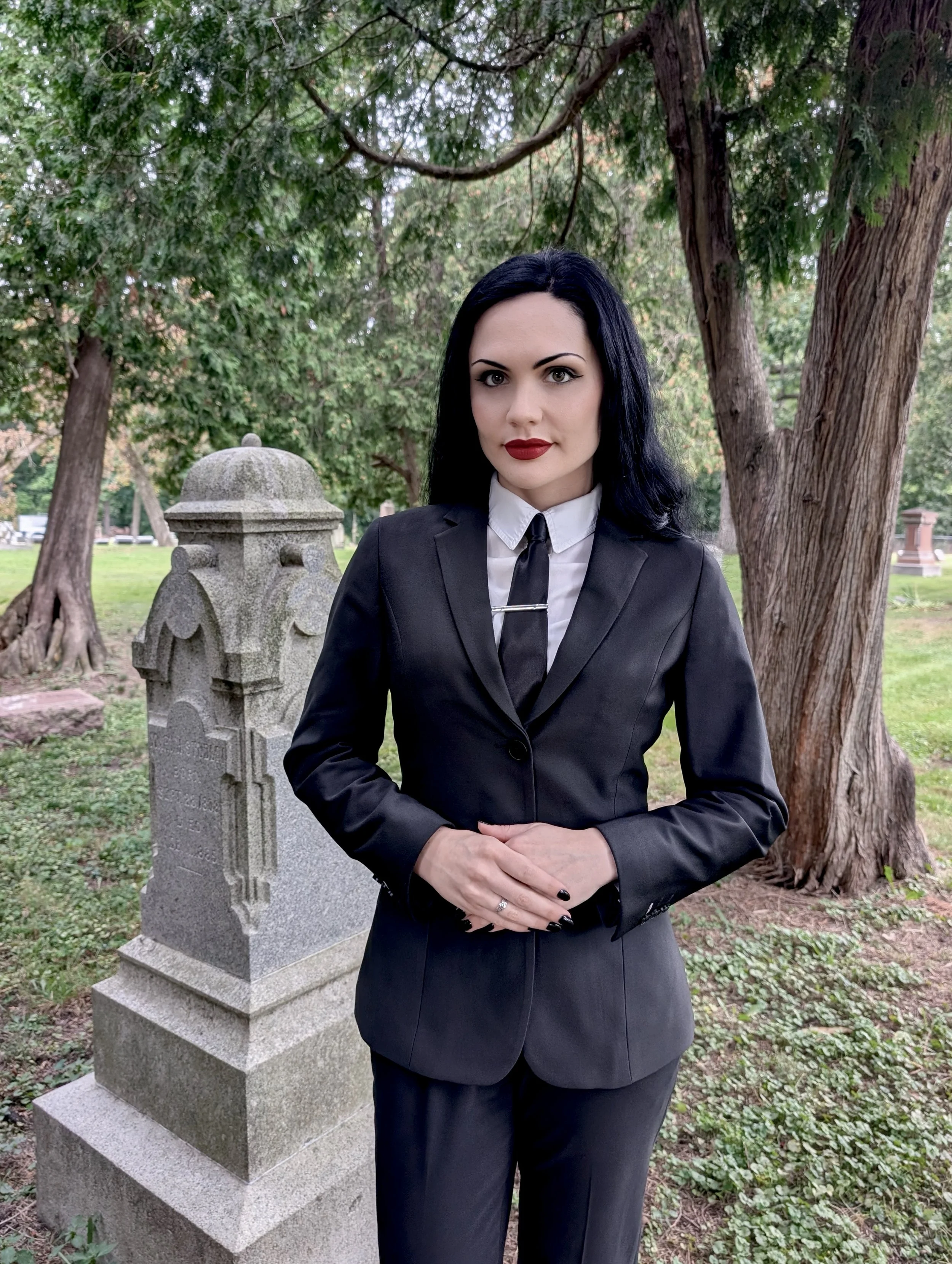
10. Lastly, congratulations on your recent design collaboration with MEA. We love seeing women in funeral service represented through thoughtful, functional design. What inspired the partnership, and how do you hope it contributes to the evolving conversation around women in the profession? Can we expect more collaborations like this in the future?
I actually have to hand over all the credit to Brandon Beck, the founder of MEA. He reached out to me on Instagram before launching his suits and asked if I would be interested in trying some, with the possibility of sharing my thoughts if I was happy with the product.
As a woman in funeral service, but especially as a disabled woman in funeral service, I was thrilled to see someone designing something stylish, comfortable, and practical. The mortuary world is changing, and we're seeing more women and people of other genders entering the field than ever before. That being said, we still face considerable societal pressure to look good, and our appearance can affect how we're perceived and treated. Finding a suit that meets those expectations while accommodating the physical demands of the job is almost impossible, and Brandon has presented an affordable solution.
I hope this collaboration encourages conversations beyond funeral service about the need for functional, accessible professional workwear, while also drawing attention to how physically demanding our profession can be. Being a mortician is definitely not just about standing around at a funeral looking put together. Before that even happens, I may spend hours lifting caskets, setting up heavy floral arrangements, lining up chairs in the chapel, and doing all sorts of other physical tasks, and it's not like I can wear athleisure to do that!
As for the future, yes, you can expect to see MEA and me collaborate again. I can't share too many details yet, but Brandon and I are currently designing a suit that incorporates elements of my aesthetic and personal style, and I'm very excited to reveal it.
Emily understands how much the smallest details can mean to a grieving family. A familiar hairstyle or carefully chosen cosmetic shade might seem inconsequential to an outsider, but these considerations can shape someone's final memory of a loved one. Her dedication to getting them right speaks volumes about the compassion she brings to her profession.
Equally moving is the story of how she found her place within it. Years spent navigating environments where her differences were misunderstood eventually led Emily to a career where those same qualities became invaluable strengths. She speaks candidly about the challenges she encountered along the way, but there's also immense joy in how confidently she embraces the person she's become. We admire her persistence in pursuing a calling that allows her to contribute so meaningfully while remaining true to herself.
Follow Emily Murman, @theautisticmortician to learn more about her work in funeral service as well as her creative pursuits. Subscribe below to receive our free monthly digital issue in your inbox, including a first look at dark feminine style and culture, the chance to vote on next month's stories and a preview of upcoming giveaways.